 David Both
Last Updated on August 29, 2023 by David Both
It is now winter here in the Northern Hemisphere and the low humidity has allowed a significant increase of static electricity. Of course there are many desert areas with very low humidity year round all over the globe. So regardless of where you live, you may find this helpful.
Although the discharge of static electricity can fry electronic components, modern personal computers, phones, and other devices are normally quite well protected from damage. So this article is more about us humans not getting zapped than it is about protecting our devices.
Static electricity discharge is a major problem. This includes lightning, discharge from the human body, and furniture discharge which, because it does not travel through your body, is the invisible form of static discharge and in reality the most common and insidious.
The generally higher moisture content of the atmosphere during the summer months in temperate zones of the globe helps to drain away static charges as quickly as they are generated. In the fall and winter however, the humidity drops and the static charges build to very high levels. When you touch something metallic you may then discharge the accumulated charge causing a spark, a slightly audible zap and a stinging, tingling sensation on your body.
The static discharges that you feel can cause a problem for your computer, but the ones you don’t feel because they are between your office furniture and the computer usually cause the worst problems. The static you don’t feel is caused when one object discharges to another. When you sit in a chair, for example, your clothing is in contact with the seat, back and arms of the chair. As you stand up from the chair your clothing is pulled away from the fabric of the chair. It is this pulling apart of two dissimilar fabrics or surfaces that generates the static buildup on the chair.
Static charges on a standard office chair can reach as high as 75,000 volts; yes that is seventy five thousand. The casters of the chair are rubber or plastic and tend to be good insulators. The charge on the chair does not dissipate at all or dissipates only very slowly. The charge on your body may dissipate more quickly if your shoes are leather and better conductors than the chair casters, and because you come in contact with other objects that help to drain the charge away from your body.
Entry Paths
Static discharge has two basic components, radio frequency interference, RFI, and the pulse of electricity conducted into the surface of your computer when you touch the case.
EMI can gain access through openings in the computer case. These access points can be caused by running the computer without the side of the case in order to facilitate easy access for various reasons and cover plates left off of the bus slots in the back of the computer. EMI can also infiltrate a computer even through a cover that is merely set in place and not fastened down with the appropriate screws. Cables connected at one end to the computer but left dangling at the other end while a peripheral is disconnected can act as antennae to capture signals and draw them into the computer.
Getting Zapped
Although modern personal computers seem to be well protected against crashes due to static discharge my personal body is not so much. I well and truly hate being zapped by static discharge and this year is shaping up to be really conducive to static build-up.
Like many previous years, I started getting zapped when I touched the metal side of my Corsair gaming keyboard, the side of the receiver, or the metal frame of my desk. I also got zapped when touching the metal frame of one desk with one hand and the metal frame of the other desk with the other hand.
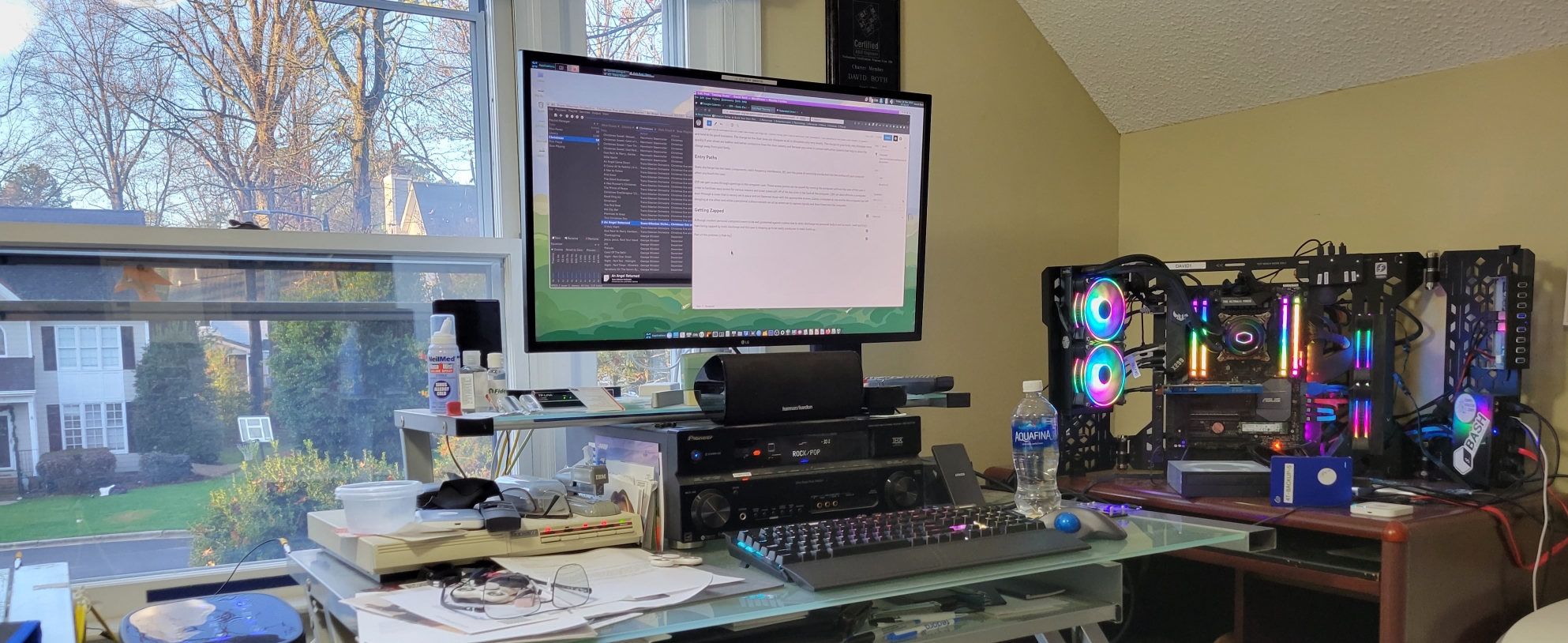
Part of the problem is that my home office setup is spread across multiple desk units of different materials, most of which are non-conductive so don’t dissipate the static charge.
My primary workstation is on the right and it sits on an old, wooden computer desk. Most of those suck but this one at least provides a flat surface for my system. The display, keyboard, and mouse, share a glass and steel desk with my receiver and three of my 5.1 speakers. You can barely see the nearly identical glass and steel desk to the left on which resides my printer and a bunch of “stuff” that just seems to collect there.
Each of these desks and the equipment on them managed to collect static charges of widely varying amounts. These differing charges are what caused the noticeable problems — like the zaps I got.
Why
The problem is not the existence of a static charge but rather the difference of the charges between the objects holding those charges. Deep explanations based in physics aside, the differing static charges between objects seeks to equalize when they are brought into contact either directly or through a third conductive object such as the human body. If all the charges are equal to start with, there is no differential to cause a discharge from one object to another.
The Fix
The picture above also shows part of my solution, and a simple one it is. See if you can find it before you proceed.
The lower left corner of the picture shows my simple solution. You should be able to see the anti-static cable with its two alligator clips with their yellow insulators clipped to the metal frame of my two glass and steel desks. There is another similar cable between the frame of my computer and the steel frame of my main desk. This simple solution equalizes the charge between my computer and the desks and prevents static discharges along with the shocks I used to receive.
Note that it is not necessary for me to wear an anti-static wristband for this to work. That might be different for you. You will just need to experiment to find out whether that is needed in your environment.
I hope this helps you have a much more comfortable dry season.


 Jim Hall
 Don Watkins