A look back: AT&T’s Unix PC
 Jim Hall
A retrocomputing “flashback” recently came across my news feed: AT&T’s “Unix PC,” a desktop workstation running Unix. I never used the Unix PC (it was slightly before my time, at least professionally) so I was surprised to learn about it.
Released in March 1985, the Unix PC sported an integrated monitor on a computer-desktop body, with a keyboard that could separate via a cable. You can also find a YouTube video that demonstrates the hardware and shows some of the features.
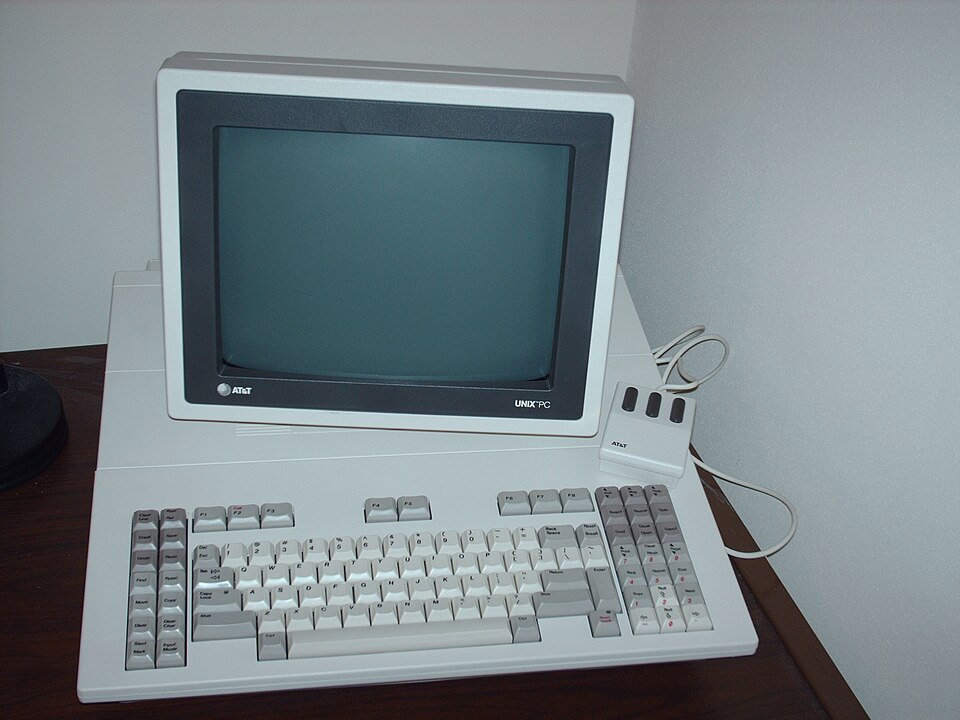
The monitor itself was a monochrome green-screen display, and although the bitmapped display was slow, it had a functional (but minimal) graphical interface that really only provided text inside frames. I actually compare the graphical interface (favorably) to another Unix system I used in the early to mid 1990s: Apollo’s Domain/OS, which also had a minimal (yet functional) graphical interface with basic windows.
Too little, too late
AT&T’s Unix PC didn’t successfully break into the “PC” market. In hindsight, it’s easy to see why: the Unix PC started development in 1983 and released in March 1985.
The computer market in 1983 was still an early time in “PC” history. The “personal computer” became a thing in the late 1970s with the Commodore PET, TRS-80, and Apple II. IBM entered the “PC” market in 1981 with the IBM PC 5150. The market was rich enough that other manufacturers were vying to enter the market, including Franklin’s Apple II clones and the Commodore 64, both of which appeared in 1982. IBM followed with the PC XT in early 1983.
AT&T’s Unix PC was developed at a time when the “state of the art” was the PC XT with 8088 CPU (4.77 MHz) 128 kB memory and 10 MB hard disk, upgradable to 640 kB memory and 20 MB disk. By comparison, the Unix PC’s Motorola 68010 CPU (10 MHz) with 512 kB memory and 10 MB hard disk, upgradable to 1 MB or 2 MB memory, seems pretty beefy for the era.
But by the time the Unix PC hit the market in 1985, the landscape had changed. Apple famously launched the Apple Macintosh in 1984, with its sporty black and white graphical interface. IBM released the PC AT in late 1984, with an 80286 CPU (8 MHz) 512 kB memory and 20 MB hard disk, upgradable to 16 MB memory. Compared to that, the Unix PC was really just “average.”
The Unix market
The Unix PC wasn’t the first “Unix desktop” system. Other vendors had already introduced the Unix “workstation” concept. Starting around 1982, Unix users could choose between Hewlett-Packard’s HP-UX operating system on HP 9000 workstations, Domain/OS on Apollo’s Domain systems, and SunOS on Sun Microsystems workstations. Or if you preferred an IBM PC, you could also run Microsoft’s Xenix.
So the Unix market was a bit crowded by the time the AT&T Unix PC was released. And the computer market was under even more pressure from the “PC wars” at the time, eventually coming down to Mac versus DOS by the end of the 1980s, then Mac versus Windows after that. With that context, it’s not too surprising that AT&T’s Unix PC didn’t gain traction.
Free Unix
Despite missing the market, the idea of a “Unix PC” remained strong. You might be familiar with a certain Finnish computer science student who developed a free Unix-like kernel in 1991, and gave it away for free under the GNU General Public License. That Linux kernel, combined with tools and utilities from the GNU Project, quickly gained traction to become arguably the most-used Unix system.
While I love using my modern Linux desktop system, I also look back fondly to the AT&T Unix PC. I never got to use it, and it’s time had come and gone by the time I first learned about “Unix” in the early 1990s, but I find its history fascinating.